
SemGlu
A high-vacuum adhesive that cures only where you focus the beam — epoxy-grade bonds for in-SEM assembly and lift-out.
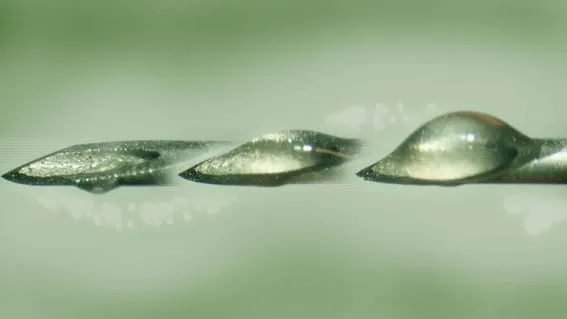
Stays liquid under the beam, cures on command#
SemGlu stays liquid at the low currents used for imaging — under 100 pA, at low magnification — so you can reposition a part against the glue without triggering a set. Curing begins only when you raise the beam deliberately: about 1 nA at the sample on FEI columns, or a 60 µm aperture on Zeiss systems, typically focused at around 50,000× magnification. A window exposure works as well, if you would rather flood a wider area than hold a tight spot.
From focused dose to a load-bearing joint#
About one minute of that higher-current exposure is enough to set a strong bond. Beam current controls how fast the glue cures, while accelerating voltage sets how deep the dose penetrates, so a full cure needs both turned up together. Once cured, the joint holds with a bond strength around 2 mN — in the same range as an epoxy-based adhesive.
Carry a reserve into the chamber#
Transfer glue from the SemGlu stub to a second stub before moving into the SEM, then use a probe-tipped micromanipulator to place it exactly where you need it. That reserve lets you complete several bonding tasks at different sites in one session, without repeating any ex-situ preparation of the sample.
Gallery
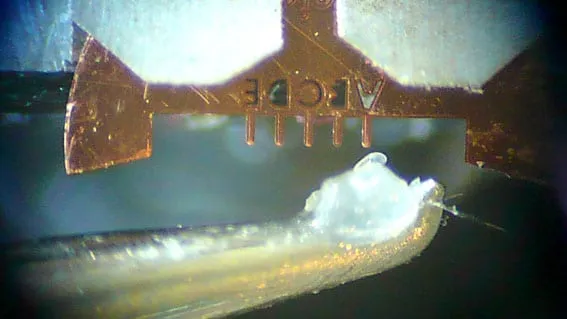
Preparation method one: transferring glue onto a TEM grid's mounting points under a light microscope. 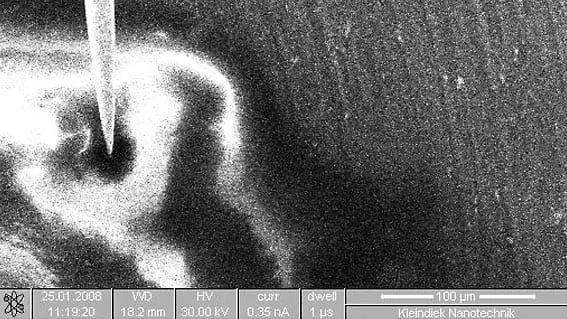
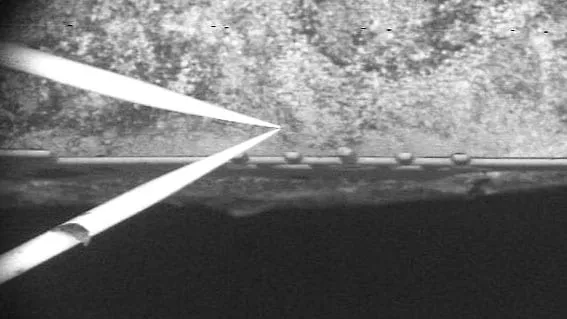
A probe tip places glue at the bonding site — 100 µm scale bar. 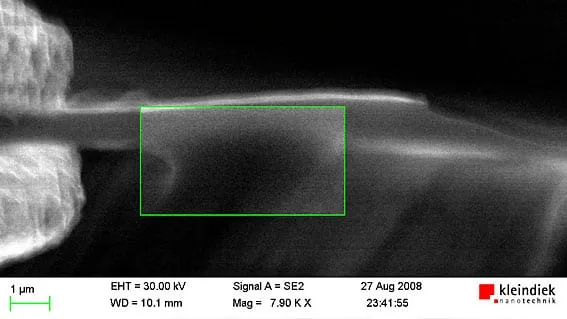
A cured joint at 7,900× magnification — 1 µm scale bar. 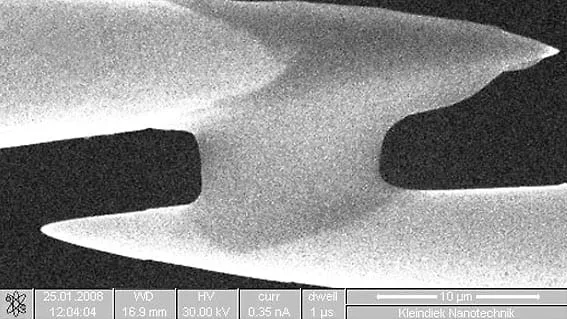
A cured bond joining two fibres — 10 µm scale bar.
Technical data
Handling
- Working beam current (uncured)
- < 100 pA
- Curing beam current
- ~1 nA (FEI) or 60 µm aperture (Zeiss)
- Curing magnification
- ~50,000×
- Cure time
- ~1 min
- Bond strength (cured)
- ~2 mN
See it run
Talk to an application engineer
Tell us your sample and your microscope — we’ll walk you through the workflow and route you to the right regional team.