The job#
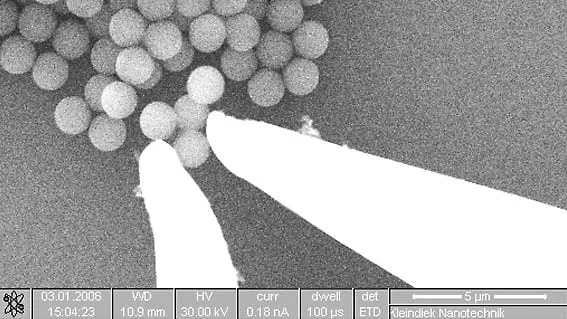
Research at the nanoscale constantly needs an object moved to a specific place: a nanowire laid across two electrodes, a particle set on a sensor, a 2D flake stacked on another. At this size the work cannot be done by hand or followed under an optical microscope, so it takes place inside the electron microscope, where the same beam that resolves the object also guides the tool onto it.
What makes it different#
Handling a sub-micron object is not just ordinary pick-and-place made smaller. Adhesion takes over: van der Waals and electrostatic forces dwarf gravity at this scale, so an object clings to whatever it touches and the awkward step is usually releasing it cleanly rather than picking it up. And the microscope gives a single flattened view, so depth has to be judged from focus and from how the tip and object shift against each other as they move. Both put a premium on motion that is fine and predictable, landing exactly where the image says it will, with nothing lost between one command and the next.
The drive#
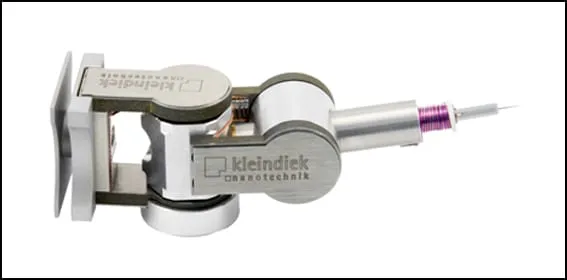
The spherical Nanomotor® drive provides that motion from a single mechanism: it carries a tip across the millimetres of the stage and then closes on a target in sub-nanometre steps, with no backlash as it switches between the two and no separate coarse stage to lose the object. From there one arm can push, lift, grasp and place an object, touch it to probe a property, or hold it while a second arm cuts, bonds or pulls.
Two arms are where this really opens up: the next page covers handling and assembly with more than one manipulator, and the video series puts the whole process on screen.