What actually ends a recording#
Two things end an intracellular recording, and both are mechanical. Slow drift, from thermal expansion or creep in the manipulator, walks the electrode off the target over the minutes to hours of a recording. Fast vibration, coupled in from the building and the rig, jolts the tip and breaks the seal in an instant. The difficulty is that the most informative recordings tend to be the longest, so the positioner has to hold against both at once, often within a micrometre of where it first landed.
The physics of staying still#
Both problems ease as the moving mechanism gets smaller and stiffer. A compact, rigid structure has a high resonance frequency, well above the low-frequency vibration a building puts out, so that energy couples into it only weakly; a short, monolithic load path also leaves little material to expand or creep. The piezo Nanomotor® drive is built around this, holding drift to the order of 1 nm/min while still resolving steps below a nanometre for the final approach.
One drive, coarse to fine#
The same drive produces both the coarse traverse and the fine approach, so a single arm covers the millimetres to the bath and then closes the last nanometre without handing the electrode to a separate coarse stage, the usual place for slack and backlash to creep in at the worst moment.
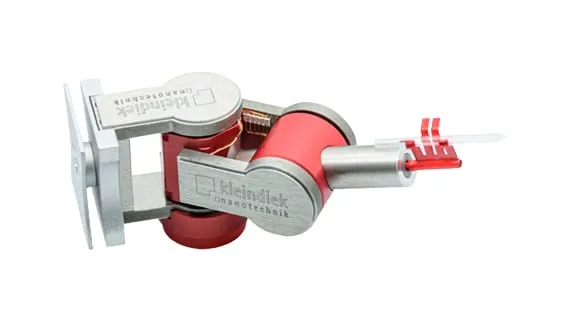
The MM3A-LS brings this to the bench for patch clamp and sharp-electrode impalement; a stripped-down single-axis in-vivo Nanomotor carries the same drive onto a freely moving animal. From here, the patch-clamp page covers the approach and the gigaseal, and separate pages cover recording in freely moving animals and impaling walled plant cells.