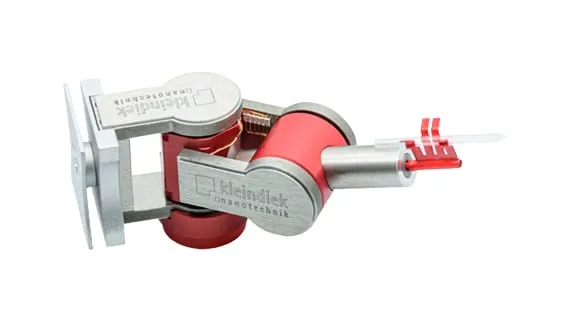
Plant cells add their own difficulty to electrophysiology: a stiff wall the microelectrode must penetrate without shattering the tip or destroying the cell, on a sample that can move as turgor changes. It calls for a manipulator that combines a firm, controlled push with fine, stable positioning.
Researchers at Würzburg used an MM3A-LS to impale individual stomatal guard cells and record their membrane potential. By working on albino leaf patches — tissue lacking functional chloroplasts — Roelfsema and colleagues separated the signalling pathways behind stomatal movement, showing that guard cells without photosynthesis still respond to blue light, CO₂ and the stress hormone abscisic acid. The manipulator’s stability is what made these single-cell impalements repeatable.