
FMS-LS
A force transducer for life science — apply and record known forces (e.g. to skin samples) alongside patch-clamp recordings.
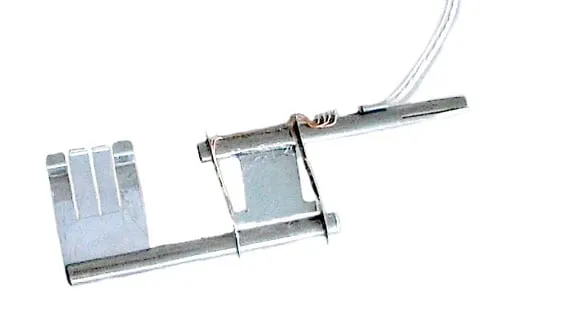
A force readout that needs no laser#
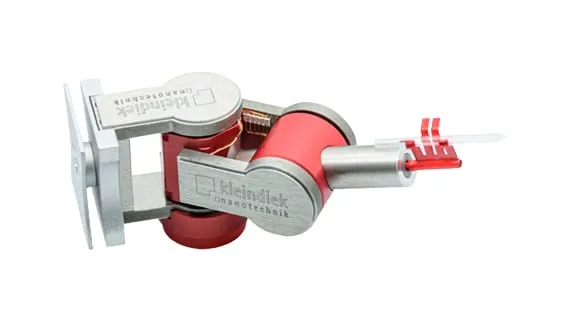
The FMS-LS is a compact force-measurement plug-in that retrofits onto an existing MM3A-LS micromanipulator, fitted with a glass capillary or a sharp silicon tip to apply and record a known force. Because the readout requires no laser, the transducer keeps the smallest outer dimensions the job allows — useful when it has to share bench space with a patch-clamp headstage. Force range runs up to 10 mN at sub-µN resolution, with a ± 10 V output; each unit is individually calibrated before it ships.
Measure by ear, then indent#
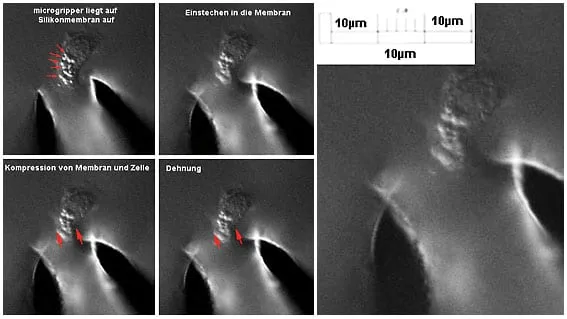
Force feedback appears on the FMS-LS controller display and, unusually, through a loudspeaker — so you can characterize a material or a micromechanical structure by its resonance frequency without watching the screen. That makes it suited to measuring the elastic parameters of cells, Young’s modulus, and the spring constants of MEMS devices. Swap in a sharp silicon tip and the same setup does nanoindentation across a wide range of materials. A typical life-science application: apply a known force to a skin sample while a patch-clamp setup on the MM3A-LS records the nerve response.
Gallery
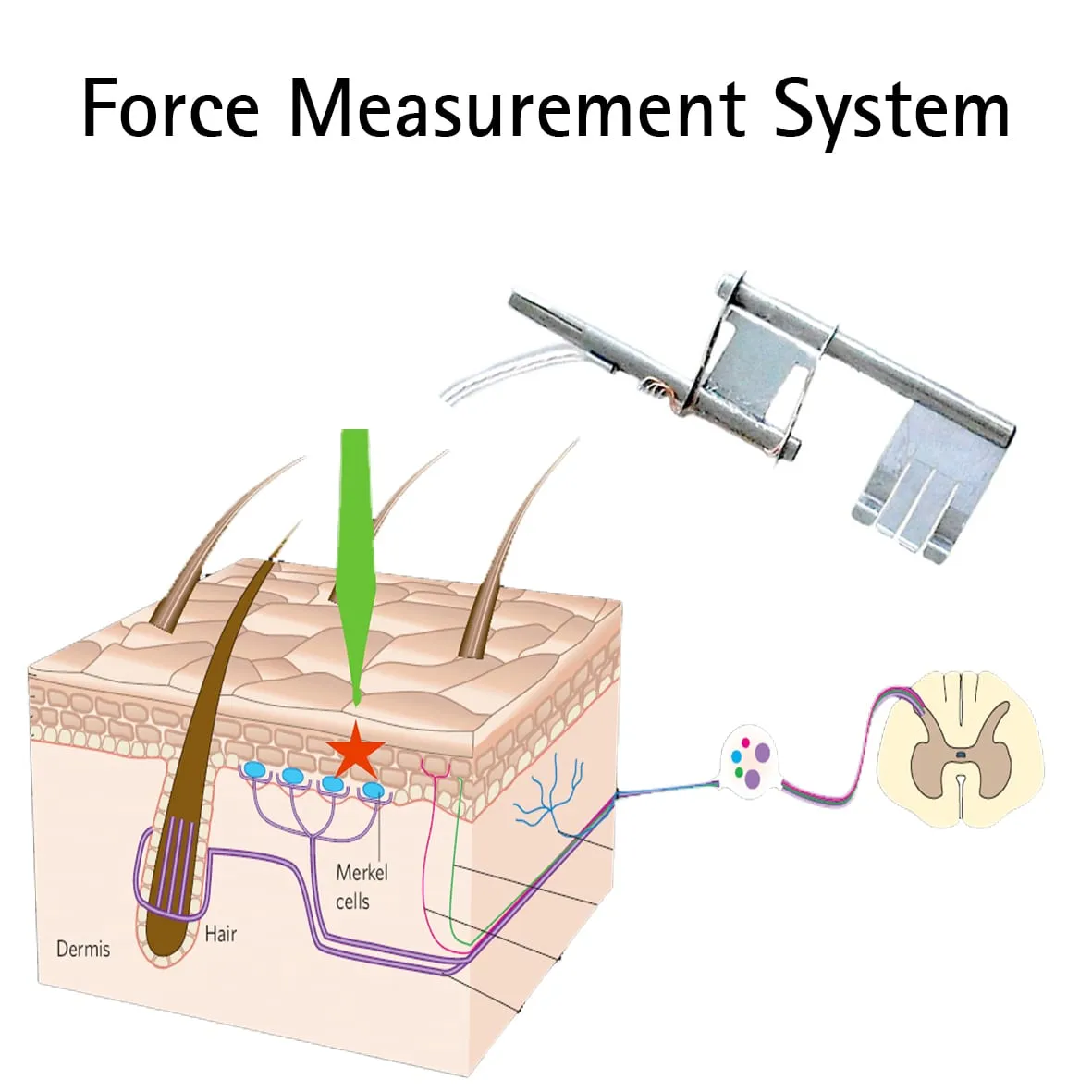
Applying a known force to skin and reading the nerve response. 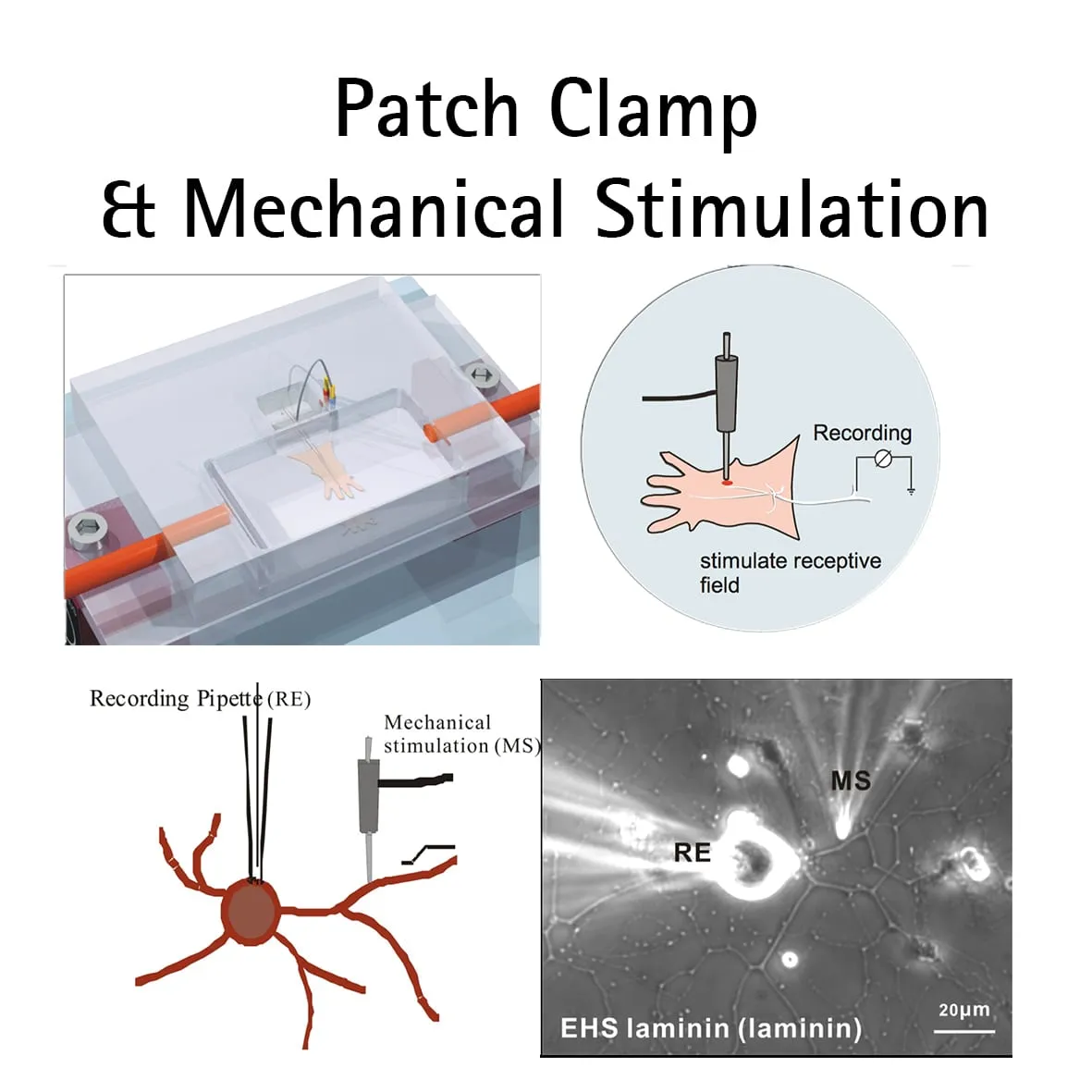
Recording electrode (RE) and mechanical-stimulation probe (MS) on a single cell.
Technical data
Overview
- Force range
- up to 10 mN
- Resolution
- sub-µN
- Output
- ± 10 V
Advantages
Laser-free force readout
- No laser needed for readout, so the outer dimensions stay as small as possible
- Retrofits directly onto an existing MM3A-LS micromanipulator
- Sharp silicon tips enable nanoindentation across a wide range of materials
- Each transducer is individually calibrated
Hear what you measure
- Force feedback on the controller display is paired with a loudspeaker
- Characterize materials and micromechanical structures by resonance frequency, by ear
- Measures elastic parameters of cells, Young's modulus, and MEMS spring constants
- Force range up to 10 mN at sub-µN resolution, ± 10 V output
What it’s used for
Talk to an application engineer
Tell us your sample and your microscope — we’ll walk you through the workflow and route you to the right regional team.