
EBIC Amplifier
A low-noise current amplifier that turns the electron beam into a defect-mapping tool — EBIC, EBAC, RCI, EBIRCH and EBIV from a single unit.
From picoamps to a live video signal#
The EBIC amplifier is a low-noise current-to-voltage converter that turns the picoamp-scale currents an electron beam induces in a sample into a video signal the microscope can display. Gain switches from 10⁴ to 10¹² V/A, the measurement floor sits at 100 fA, and the amplifier tracks signals up to 10 MHz of bandwidth — enough headroom to follow fast beam-induced transients as well as slow, quiet defect currents.
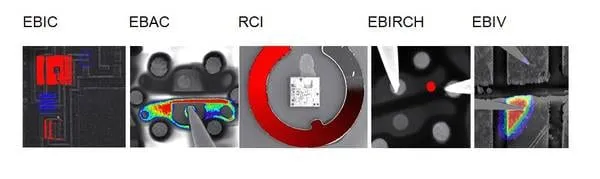
One amplifier covers five related nanoprobing techniques — EBIC, EBAC, RCI, EBIRCH and EBIV — reached by combining AC or DC amplification, image inversion and an applied sample bias, without swapping hardware. EBIC separates electron-hole pairs at a p-n junction; EBAC and RCI instead read current diffusing into metal wires contacted by the probe tips, distinguishing low- and high-ohmic connections; EBIRCH tracks a resistance change under beam injection; EBIV maps voltage drops down to a few ohms of difference. Because all five read beam-induced current rather than surface topography, a fault can be localized on 3 nm-class devices without removing the passivation layer.
The video output is variable to adjust to the what the microscope expects and feeds straight into the microscope’s video input — the operator watches the defect site light up as the beam scans across it.
From wafer-scale opens to 5 nm FinFETs, and beyond…#
Selectable input current compensation and a large offset range keep the signal centred as gain climbs into the 10¹² V/A range. On a via chain of 180 elements, EBIRCH isolates a single low-ohmic failure among hundreds of nominally identical structures; on a 14 nm device, RCI separates open from closed current regression through a 1 MΩ resistance structure. The amplifier’s job throughout is the same — hold the noise floor below 100 fA while the gain does the work of making a femtoamp visible.
Gallery
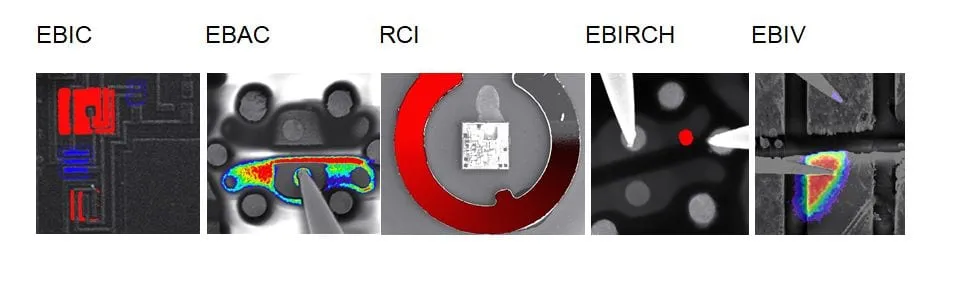
One amplifier, five techniques — EBIC, EBAC, RCI, EBIRCH and EBIV. 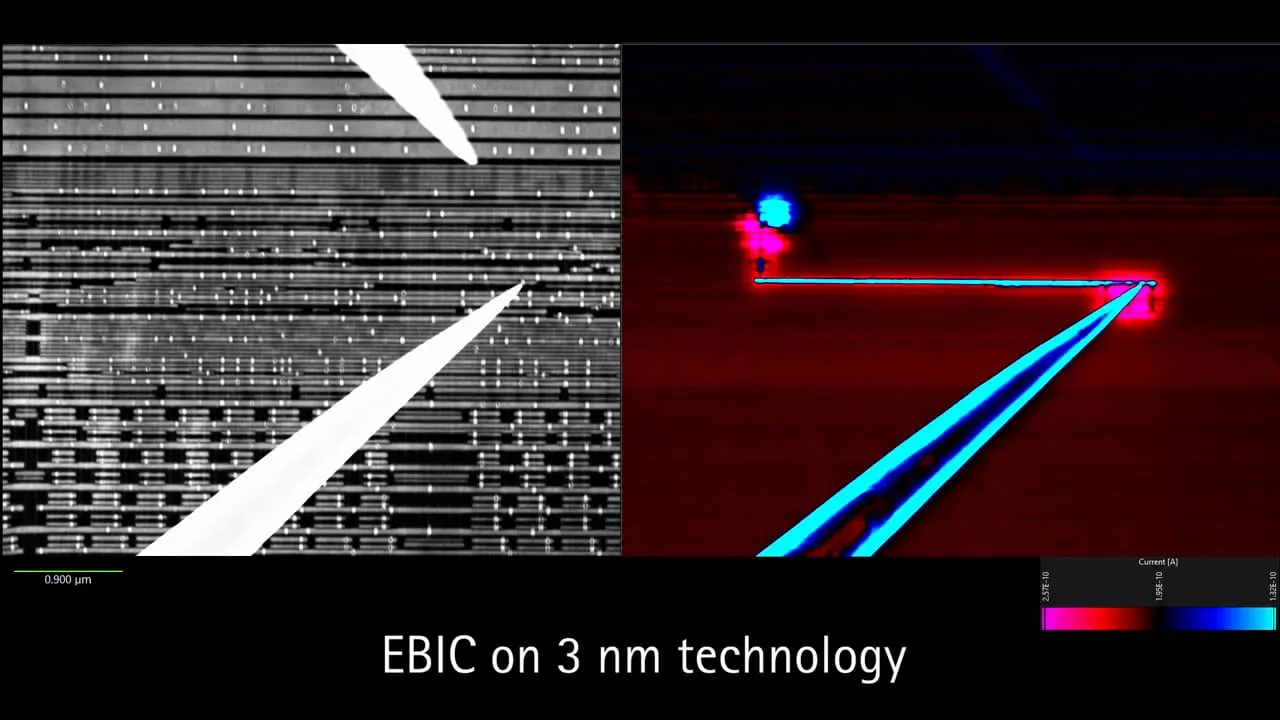
EBIC on 3 nm technology sample. 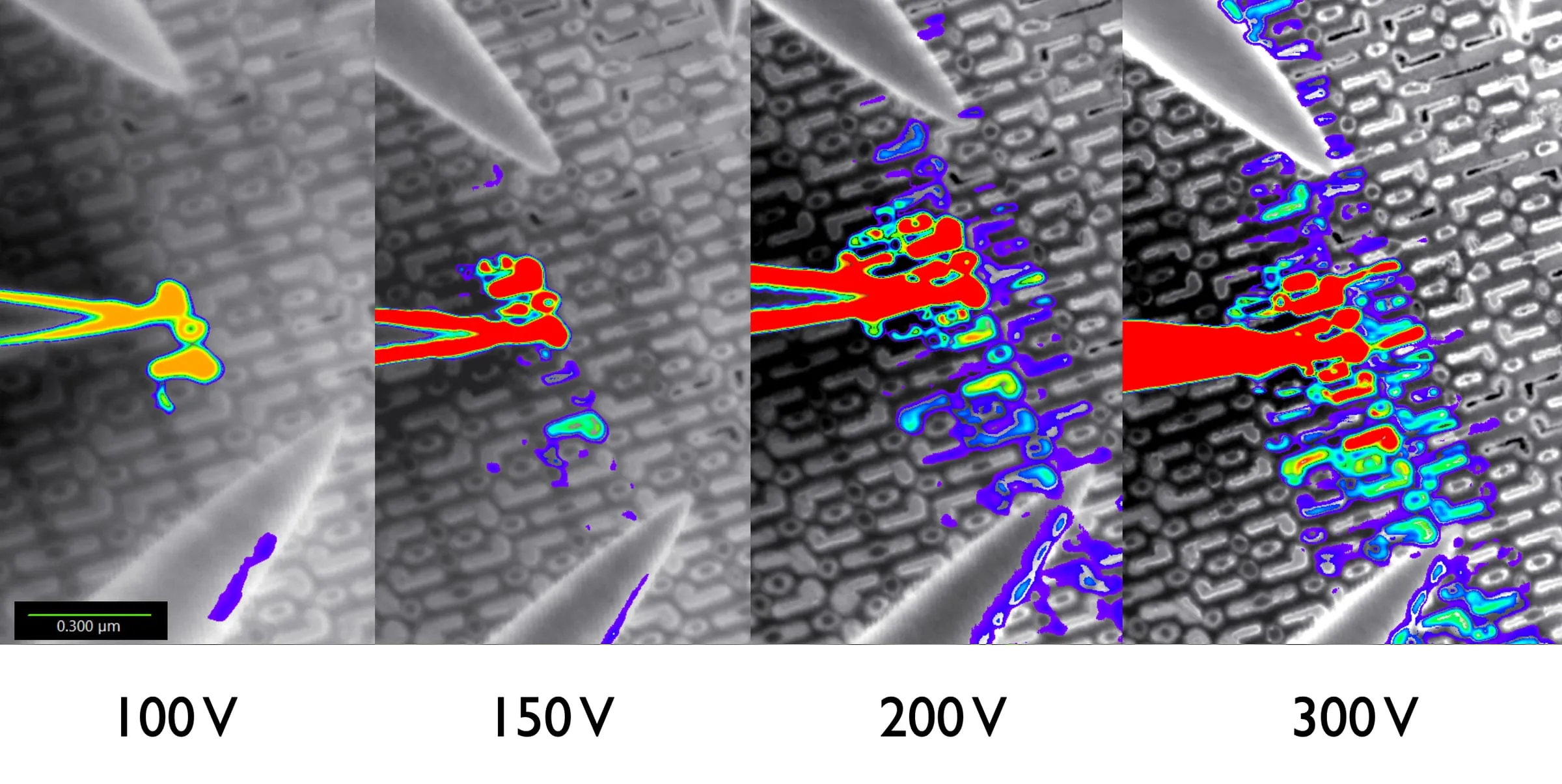
EBAC using varying beam voltages. 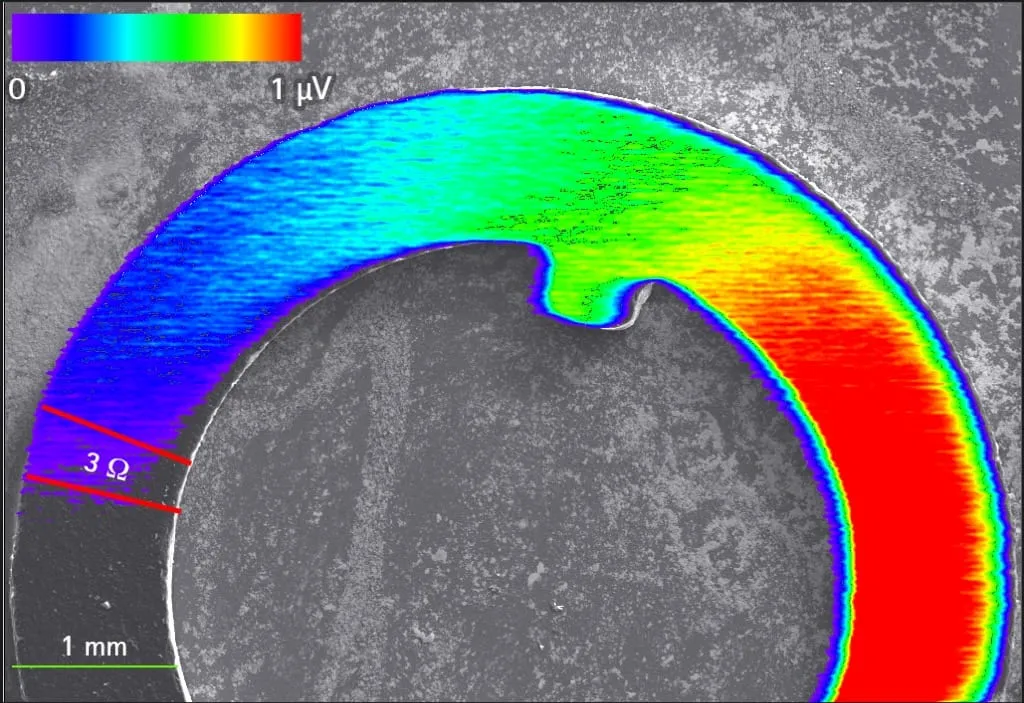
EBIV resolving a 3 Ω resistance difference. 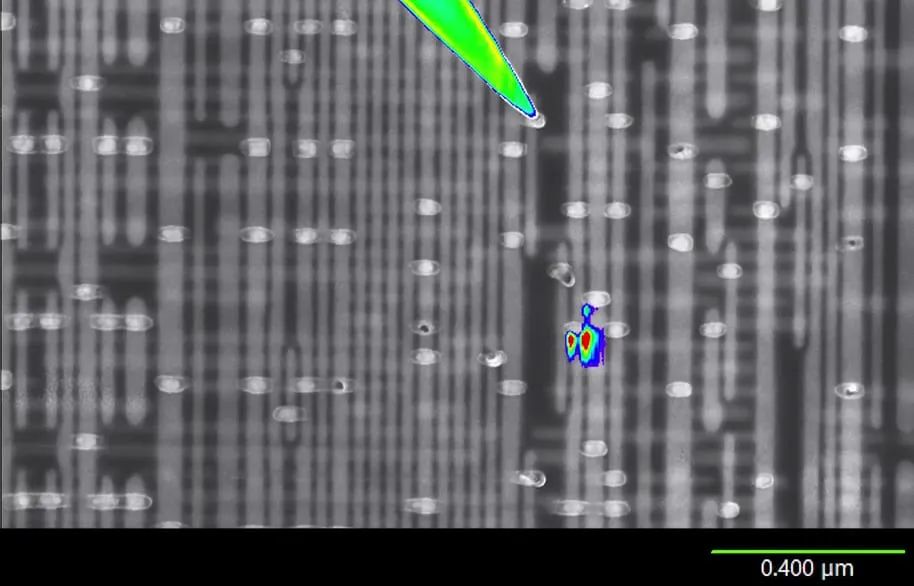
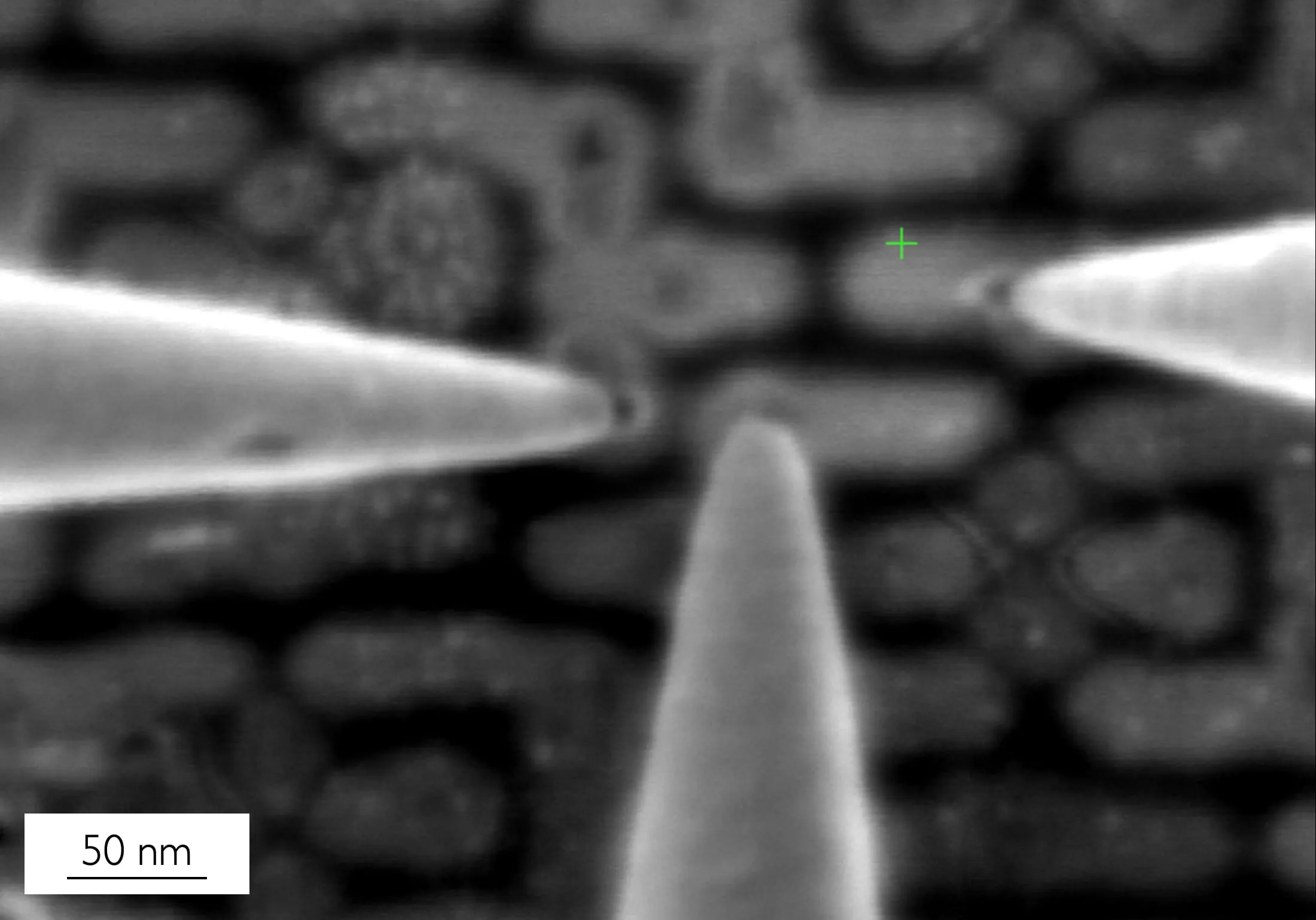
Localizing a sub-micron current path between two probe tips. 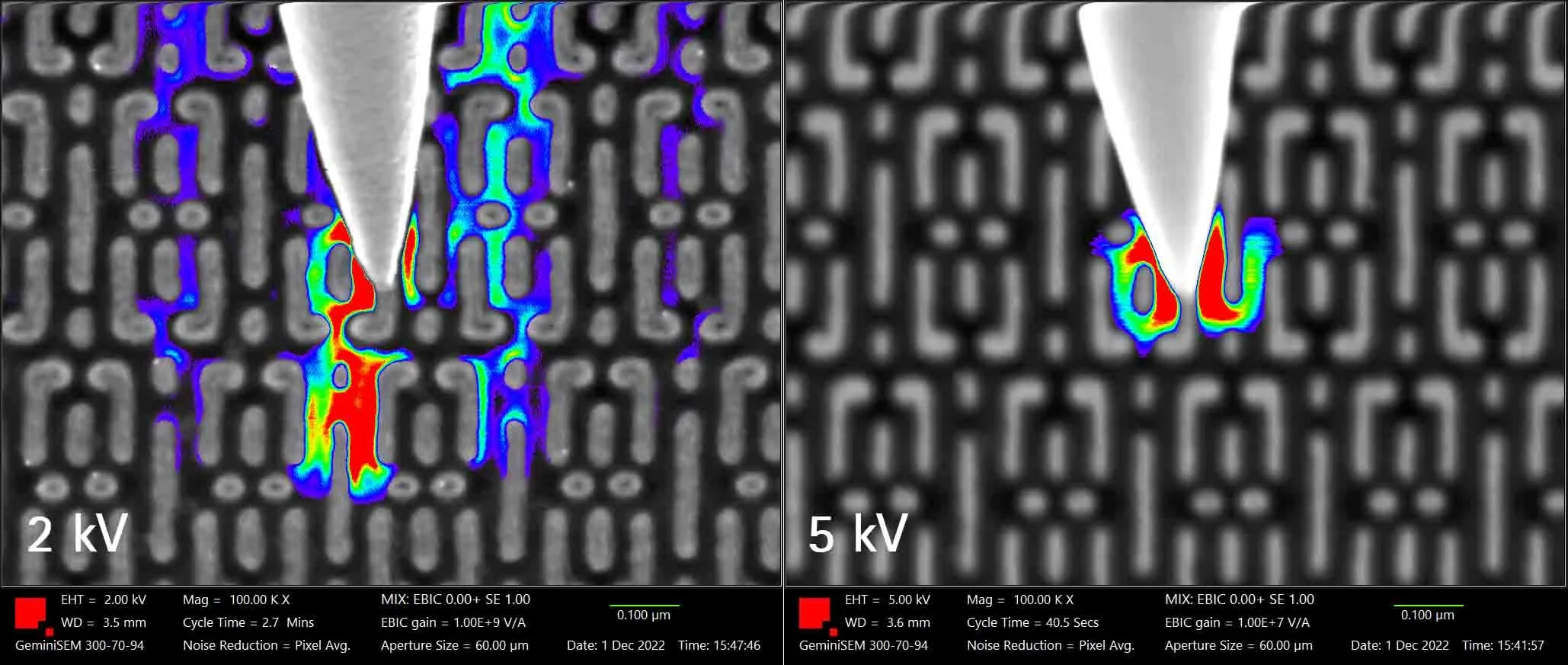
Beam energy sets penetration depth — 2 kV versus 5 kV on the same structure.
Technical data
Overview
- Current measurement limit
- 100 fA
- Gain
- 10⁴ to 10¹² V/A
- Bandwidth
- Up to 10 MHz
- Video output
- 1 V / 50 Ω, software-configurable
- Current leakage
- < 50 fA/V
See it run
Advantages
More flexible and more quantitative
- AC and DC amplification modes
- Image inversion mode
- Quantitative EBIC/EBAC readout
Cleaner and quieter
- Selectable bandwidth filter
- Input current compensation
- Large offset range with external voltage input
Application articles
EBIC — Electron-Beam-Induced Current
Mapping where a device collects beam-generated carriers, to image p–n junctions, depletion regions and recombination sites.
EBAC — Electron-Beam Absorbed Current
Tracing conductive paths and finding opens in interconnects, with no bias applied to the device.
RCI — Resistive Contrast Imaging
Two-contact current-division imaging that reveals the resistance distribution along a net.
EBIRCH — Electron-Beam-Induced Resistance Change
Biased, AC current imaging that lights up resistive and leaky defects as bright spots.
EBIV — Electron-Beam-Induced Voltage
Reading the beam-induced voltage to reach high-impedance and floating nodes that current maps miss.
Related products & accessories
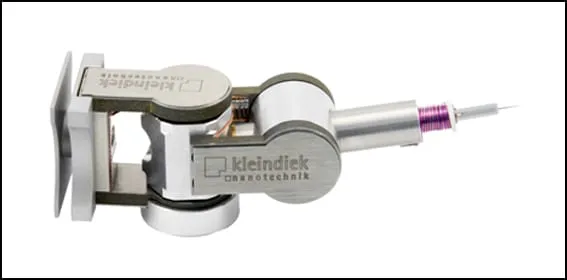
MM3A-EM
The industry-standard spherical micromanipulator — the platform every Kleindiek plug-in tool attaches to, with 3000+ units in the field.
View product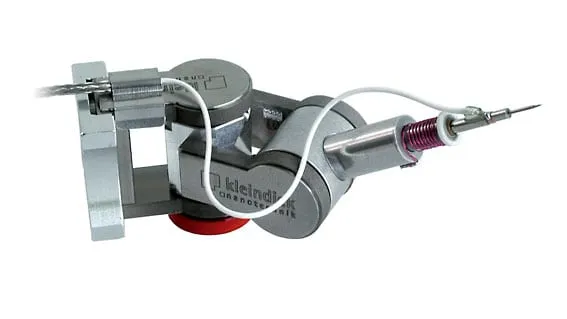
Probe-Tip Holder LCMK
A low-noise, low-resistance probe-tip holder that turns a Kleindiek manipulator into a precision nanoprober — resolving currents down to 3 fA.
View productTalk to an application engineer
Tell us your sample and your microscope — we’ll walk you through the workflow and route you to the right regional team.