Beam heating makes the defect show itself#
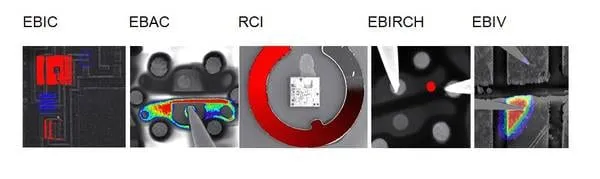
EBIRCH finds the defect itself. Two probes land on contacts either side of a suspected fault and a bias is applied across the path. As the electron beam scans, local beam heating at a defect changes that defect’s resistance, which changes the current flowing through the biased path. Mapping the current change makes defects appear as bright spots, exactly where they are.
AC mode, read against the layout#
The EBIC amplifier reads the current change in AC mode, and the resulting map is compared with the parallel secondary-electron image and the circuit layout to fix the defect’s position; tuning the accelerating voltage reaches defects at different depths. As with the other current-imaging modes, the passivation need not be removed and the surface is not damaged.
Shorts, leaky junctions, and defects in three dimensions#
Directly localizing resistive shorts, leaky junctions and weak or defective contacts. It is often the fastest route from “this net fails” to “the defect is here.” Combined with sequential FIB cross-sectioning, the same probes build a three-dimensional picture of buried defects.