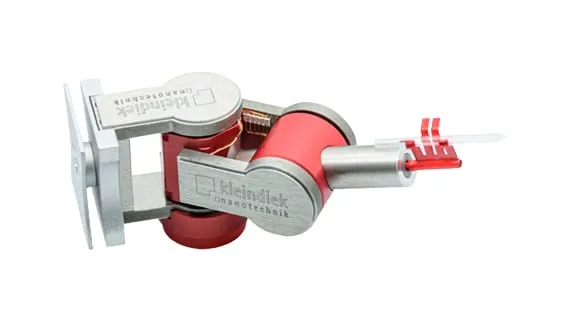
The workhorse assay of mechanotransduction is simple to state and hard to do well: while patch-clamping a cell, drive a fire-polished glass probe against its membrane in small, precise steps and record the current that flows. The kinetics of that current, how fast it switches off, distinguish rapidly-, intermediately- and slowly-adapting (RA, IA, SA) mechanically activated conductances, which point to different channels.
Resolving those kinetics needs displacement that is both fine and fast. An MM3A Nanomotor® supplies it: sub-micron indentation steps delivered at a controlled velocity (around 1 µm/ms), with the command signal timed against the recording so the current can be aligned to the moment of contact.
This setup underpins a body of landmark work from the Lewin group and others: mapping where in a sensory neuron mechanical currents arise (Hu & Lewin), identifying the stomatin-domain protein SLP3 as essential for touch in mice (Wetzel et al., Nature), and tying a T-type calcium channel to mechanoreceptor function (Shin et al., Nature Neuroscience).